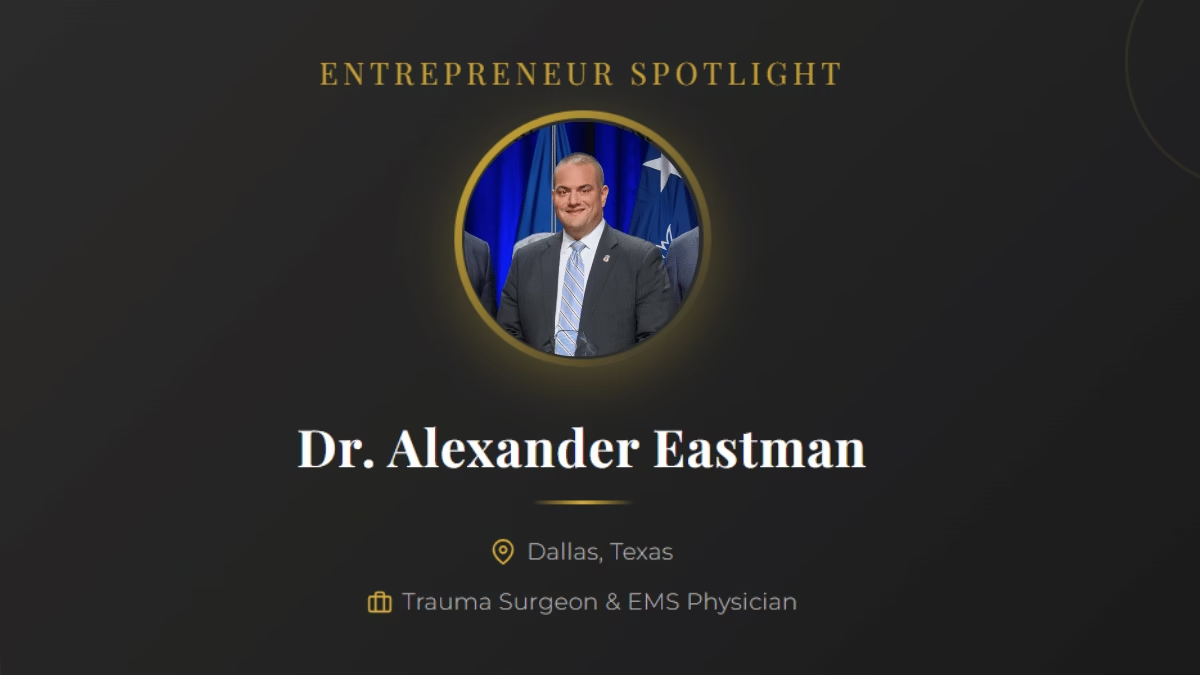
For young professionals entering careers in trauma surgery, emergency medicine, public health, or emergency preparedness, there can be a lack of clarity about available career paths. There is often a distinction between clinical medicine and public health. Hospitals and medical facilities can feel far away from law enforcement departments. It is common to feel that federal policy is too abstract and unrelated to real-world emergencies. Dr. Eastman’s work will provide a different view. A career defined by the principle that these systems are interconnected and meaningful impact is achieved through the integration of these systems and the spaces between them.
Dr. Eastman is a board-certified trauma and general surgeon practicing in Dallas, Texas. He has spent more than twenty years in trauma surgery and emergency medicine. He has practiced at hospitals, law enforcement agencies, and federal emergency preparedness offices throughout his career. However, Dr. Eastman has developed his career through deliberate and purposeful steps and decisions rather than a series of dramatic leaps.
As a result, Dr. Eastman’s experiences offer practical examples of how complex systems operate under pressure and how their successful execution ultimately relies upon the collective preparedness and capabilities of the personnel involved in the process. Those at the beginning stages of their careers would be well advised to consider Dr. Eastman’s career a model for achieving similar success.
Trauma Resuscitation Technician Experience
Dr. Eastman began his exposure to emergency medicine prior to earning a medical degree. In the mid-1990s, while attending the University of Texas at Austin as an undergraduate student, he worked as a trauma resuscitation technician at Suburban Hospital in Bethesda, Maryland. Suburban Hospital is a Level II trauma center and is part of the Johns Hopkins Medicine System. Working as a trauma resuscitation technician provided Dr. Eastman with the opportunity to observe the realities of emergency care firsthand before attending medical school.
While working in the trauma bay, Dr. Eastman saw firsthand the effect of delays in the treatment of traumatic injuries. Delays in treatment can lead to irreversible consequences. He also witnessed how coordinated teams, rather than relying on individual efforts, determine whether patients live or die.
Dr. Eastman’s experience as a trauma resuscitation technician illustrates the benefits of early hands-on experience in a field related to emergency medicine. Additionally, the experience offers information about the functions of the systems that comprise the overall emergency care system.
Medical Education and Clinical Training
Dr. Eastman graduated from the University of Texas at Austin in 1996 with a BA in the Plan II Honors Program. He attended George Washington University School of Medicine and Health Sciences, graduating in 2001. After completing his medical degree, he returned to Texas and completed his general surgery residency at the University of Texas Southwestern Medical Center in Dallas.
During his residency at the University of Texas Southwestern Medical Center and Parkland Memorial Hospital, one of the busiest trauma centers in the nation, Dr. Eastman observed a concerning trend. Patients suffering from critical injuries were arriving at the hospital after the time frame in which surgical intervention would no longer affect the outcome of the injury.
Dr. Eastman did not attribute these lost lives to inadequate in-hospital care. Rather, he attributed the lost lives to the time delay between the injury and the time when the patients arrived at the hospital.
This observation made a significant impact on Dr. Eastman’s future endeavors. For young physicians currently in training, Dr. Eastman’s observations demonstrate the importance of questioning assumptions. Dr. Eastman questioned whether the existing separation between prehospital care and hospital medicine created unnecessary barriers to delivering timely care to critically injured patients.
Revisiting Traditional Roles in Trauma Care
While a resident in 2004, Dr. Eastman presented the Dallas Police Department with an innovative idea. He proposed to embed trauma surgeons within law enforcement tactical units so that immediate medical care could be initiated at the site of injury rather than upon arrival at the hospital.
Despite challenging traditional roles, Dr. Eastman’s proposal was based on the fundamental principle that time equals life. The Dallas Police Department agreed to pilot the concept, and Dr. Eastman joined the Dallas Police Reserve Program and trained with the SWAT unit. Eventually, Dr. Eastman held the rank of reserve lieutenant with the Dallas Police Department.
With Dr. Jeffrey Metzger, Dr. Eastman co-founded the Tactical Medic Program of the Dallas Police Department and developed the protocols, equipment standards, and training programs for the program based upon real-time trauma cases.
Younger professionals interested in pursuing careers spanning multiple fields should find Dr. Eastman’s experience relevant, illustrating how innovation often arises from redefining where expertise exists and when it can be applied across the continuum of care.
Validation of Tactical Medicine Through Operational Use
The tactical medic program was put to the test in real-world applications. During a federal warrant service in North Oak Cliff in 2007, a SWAT officer was shot. The tactical medic team’s immediate medical care enabled the officer to survive.
Experiences such as the shooting of the SWAT officer validated the concept of embedding advanced medical capacity into high-risk operations. For those who are contemplating careers that integrate multiple fields, Dr. Eastman’s experience demonstrates that credibility is established through preparation and performance, not solely through theoretical constructs.
Parkland Memorial Hospital Leadership Position
In 2009, Dr. Eastman became an assistant professor in the Division of Burns, Trauma, and Critical Care at UT Southwestern. He received a teaching award in 2011. Around 2014, he acted as interim chief of trauma surgery. In 2015, he was appointed medical director and chief of the Rees-Jones Trauma Center at Parkland Memorial Hospital.
Parkland Memorial Hospital is one of the busiest Level I trauma centers in the United States, handling approximately 100,000 emergency department visits per year. As medical director of the Rees-Jones Trauma Center, Dr. Eastman focused on developing a reliable system rather than on individual clinicians’ performance. He stressed the need for surge planning, communication protocols, equipment staging, and the coordination of emergency medicine, surgery, prehospital providers, and hospital administration.
For young clinicians, this aspect of Dr. Eastman’s career highlights an often-overlooked aspect of leadership. Successful trauma care is dependent not only on clinical proficiency but also on the reliability of the system operating under extreme stress.
Dallas Police Ambush in 2016
On July 7, 2016, a gunman ambushed police officers in downtown Dallas, killing five officers and injuring nine others. Dr. Eastman provided medical care at the scene of the ambush and assisted with coordinating the hospital response at Parkland Memorial Hospital, transitioning the hospital into mass-casualty operations.
Following the ambush, Dr. Eastman received the Dallas Police Department’s Medal of Valor.
Dr. Eastman continues to emphasize that the survival of the victims of the ambush was due to the availability of equipment, the quality of the training provided to law enforcement and medical teams, and the coordination of these teams rather than individual heroism.
For young professionals, Dr. Eastman’s response to the ambush demonstrates an essential lesson. The effectiveness of a response to a crisis is determined by the preparation that occurred beforehand.
Training is the most reliable technology.
Throughout his career, Dr. Eastman has advocated that training is the most reliable form of technology in responding to emergencies. Dr. Eastman leads the medical component of the Dallas Police Department SWAT unit and is responsible for training it. This training includes simulation-based exercises, blindfolded drills, and repeated assessment of medical staff performance.
Dr. Eastman has emphasized that advanced medical technologies are only as effective as the personnel applying them. This philosophical perspective has guided Dr. Eastman’s approach to trauma care, tactical medicine, and federal preparedness. For young professionals who have grown accustomed to rapid advancements in technology, Dr. Eastman’s perspective serves as a reminder that systems, skills, and repetition are equally as important as innovation.
Hartford Consensus and National Frameworks
Dr. Eastman participated in the development of the Hartford Consensus, a multidisciplinary initiative to improve survivorship during active shooter and mass-casualty events. In the course of this work, Dr. Eastman participated in developing the THREAT model, which incorporates the concepts of threat suppression, hemorrhage control, rapid extraction, assessment, and transportation.
Dr. Eastman has also been a proponent of the Stop the Bleed (STB) program, which seeks to educate the public in the application of bleeding control techniques. By 2025, the STB program reported having educated well over 5 million people globally. Dr. Eastman co-authored the 2022 review article “Stop the Bleed®” in Current Problems in Surgery. Dr. Eastman has written extensively on prehospital response and mass-casualty care.
For students and trainees, Dr. Eastman’s work exemplifies how research, policy, and education can result in tangible public health impact.
Peer-Reviewed Research and Evidence-Based Practice
Dr. Eastman has written between 20 and 40 peer-reviewed articles on topics including trauma systems, tourniquets, mass-casualty response, and crisis leadership. His research has demonstrated the potential to save hundreds of lives annually through widespread public use of tourniquets.
Dr. Eastman has also written about the prevention of distracted driving and demonstrated statistically significant decreases in at-risk behaviors among adolescents following targeted interventions. His studies further demonstrate the utility of evidence-based practices and post-event review in both research and operational contexts.
U.S. Department of Homeland Security and Federal Emergency Response
In 2016, Dr. Eastman joined the U.S. Department of Homeland Security (DHS) Office of Health Security as senior medical officer, operations. He later served as the acting chief medical officer for U.S. Customs and Border Protection. In these roles, Dr. Eastman has shaped national clinical preparedness, emergency planning, and officer health initiatives, including COVID-19 response coordination.
He has supervised the training of thousands of federally certified EMTs working in high-risk environments. Dr. Eastman has a clinical practice in Dallas with a direct link to patient care.
Practical Lessons for Emerging Professionals
Dr. Eastman frequently states that “preparation is the most meaningful work we do,” regardless of the level of visibility. Dr. Eastman emphasizes the importance of system reliability, redundancy, and ongoing improvement in crisis preparation. He advocates conducting post-event analysis, establishing cooperative relationships with other agencies, and empowering civilians with simple tools such as tourniquets and compression bandages.
For young professionals entering careers in medicine, public health, or emergency preparedness, Dr. Eastman’s experience provides a practical guide. Lasting impact depends on commitment, collaboration, and focus on the essential work that builds resilient systems.

