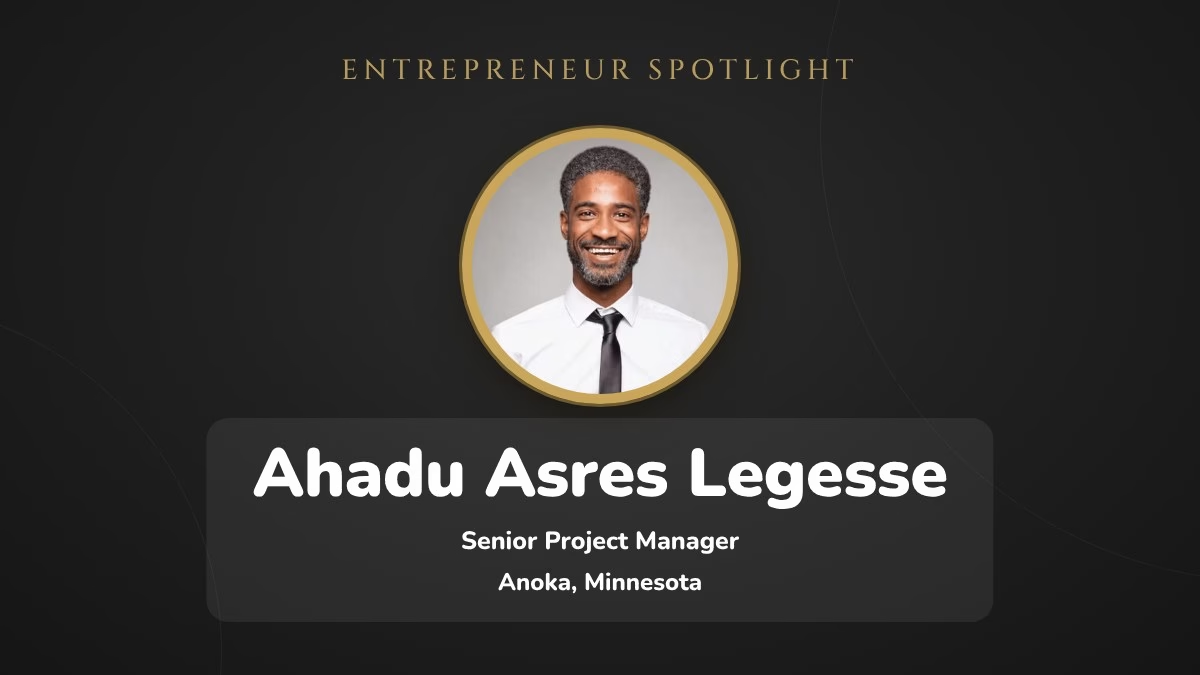
Ahadu Asres Legesse is a senior project manager in business operations from Anoka, Minnesota, who has spent more than 28 years building and fixing the internal systems of large companies, including Target, U.S. Bank, Medtronic and UnitedHealth Group. His work points to a lesson many founders learn the hard way: a business scales on its systems, not its ideas. The habits are simple. Write down how work gets done, give every task one owner, set realistic schedules, report on a steady rhythm, treat new tools as a change for people, and improve in small steps.
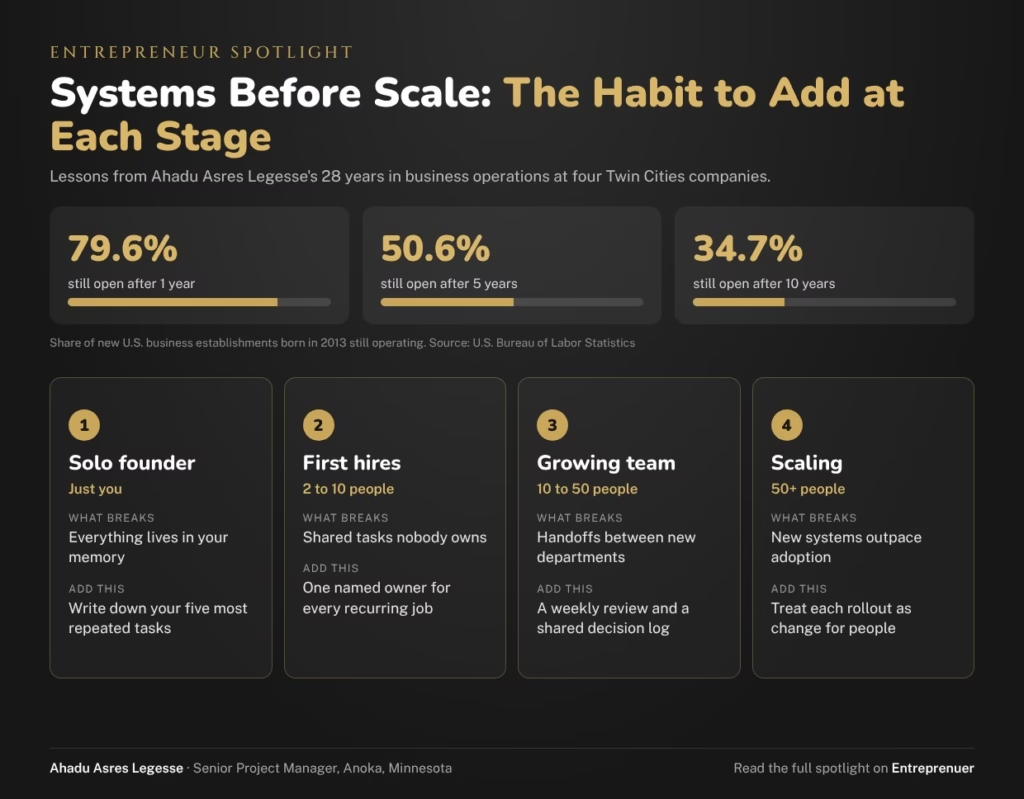
Founders are rightly celebrated for ideas. But the numbers on what happens next are sobering. According to the U.S. Bureau of Labor Statistics, about 79.6 percent of business establishments that opened in 2013 were still operating one year later. By the five-year mark that figure was 50.6 percent, and after ten years it was 34.7 percent. Businesses close for many reasons, from funding to markets to timing. Yet anyone who has watched a promising company stall knows a familiar pattern: demand arrives, the team grows, and the informal way of doing things that worked for five people collapses under fifty.
Ahadu Asres Legesse has spent his career on the other side of that moment. He has never founded a startup. He has worked inside organizations that already made the leap from idea to scale, on the part of the business that keeps them running: schedules, handoffs, procedures, systems and the people who use them. That vantage point is exactly why his habits are worth a founder’s attention.
Who Is Ahadu Asres Legesse?
Legesse grew up in Anoka, Minnesota, about 20 miles northwest of Minneapolis, and graduated from Anoka High School in 1992. He earned an Associate of Arts from Anoka-Ramsey Community College in 1994 and a Bachelor of Science in Business Administration from Metropolitan State University in Saint Paul in 1997.
His career has run entirely through the Twin Cities:
- Target Corporation, Minneapolis (1998 to 2004): operations analyst and project support specialist, preparing management reports, tracking department activities and maintaining project records.
- U.S. Bank, Minneapolis (2004 to 2012): project coordinator, then project manager from 2008, leading technology updates, administrative procedure changes and operational improvements.
- Medtronic, Fridley (2012 to 2020): project manager in operational excellence, reviewing workflows, standardizing procedures and supporting teams through change.
- UnitedHealth Group, Minnetonka (2020 to present): Senior Project Manager in Business Operations, leading cross-functional projects across operations, IT and business support teams, and mentoring junior project coordinators.
Four industries, one consistent job: getting groups of people with different priorities to deliver one plan, then keeping it on track as conditions change.
Why Should Founders Learn From a Corporate Project Manager?
Large companies are, in one sense, what successful startups become. The problems Legesse has worked on, such as coordinating departments, rolling out new systems, and standardizing how work gets done, are the same problems a growing company meets for the first time around its first dozen hires. The difference is that a large company has learned, often expensively, which habits hold up under pressure.
Small businesses carry real weight in the economy. The SBA Office of Advocacy counts about 34.8 million small businesses in the United States, making up 99.9 percent of all firms and employing about 45.9 percent of private-sector workers. Most of those firms never adopt formal project management, and they do not need to. What they need are the handful of habits underneath it.
Lesson 1: Write Down How the Work Actually Gets Done
Legesse’s first job at Target involved maintaining records, spreadsheets and reports that documented how departments operated. Years later at Medtronic, much of his work involved reviewing how teams completed their daily tasks, identifying delays or unnecessary steps and recommending improvements. Both jobs start from the same place: you cannot improve, delegate or scale a process that lives only in someone’s head.
For founders: list the five tasks your business repeats most often, such as onboarding a customer, sending an invoice or fulfilling an order. Write each one down as it really happens, including the workarounds. That document becomes your first training manual and the first place you will spot waste.
Lesson 2: Give Every Task One Owner
Legesse’s approach to project management rests on a simple principle: people should understand what needs to be done, who is responsible and when it is expected to be finished. Several people can contribute to a task, but one person owns it.
For founders: early teams share everything, which feels collaborative until something falls through the gap. The moment you have more than three people, put a single name next to every recurring responsibility. “We” is not an owner.
Lesson 3: Set Realistic Schedules, Then Protect Them
As a project manager at U.S. Bank, a large part of Legesse’s work was keeping projects within their approved scope and timelines. That discipline means planning honestly and telling people when a new request will move the schedule. He has consistently favored realistic deadlines over optimistic ones.
For founders: optimism raises money and wins first customers, but it makes poor scheduling. Build buffer time into launches and hires, and when a customer or investor adds a request, decide openly what moves to make room for it.
Lesson 4: Build a Reporting Rhythm Before You Need One
Preparing regular progress reports for leadership has been part of every role Legesse has held, from coordinator to senior project manager. The value is less in any single report than in the rhythm: people stop chasing information when they know it is coming.
For founders: start a 15-minute weekly review now, even with a team of two. Cover what got done, what is next, what is stuck and which decisions are waiting on you. When you add investors, a board or managers, the habit is already in place.
Lesson 5: Treat New Tools as a Change for People, Not a Purchase
At UnitedHealth Group, Legesse supports the introduction of new business systems and procedures, from planning implementation schedules to helping teams adjust after launch. At Medtronic, his work continued after recommendations were made: supporting employees through transitions, updating documentation and helping teams adapt.
For founders: a new CRM, accounting platform or project tool will not fix a messy process. It will speed it up. Clean up the process first, explain to the team what is changing and why, train close to launch and name one person to answer questions for the first month.
Lesson 6: Small Improvements Compound
Operational excellence work rarely looks dramatic. It is a series of modest changes: one approval removed, one checklist added, one handoff clarified. “Why Small Improvements Lead to Bigger Results” is one of the planned topics for The Steady Progress Podcast, which Legesse is developing as a series on work, leadership and career growth.
For founders: pick one recurring frustration each month and fix it permanently. Twelve small fixes a year add up to a noticeably calmer company.
What Do These Habits Look Like at Each Stage of a Business?
| Stage | What usually breaks | The habit to add |
|---|---|---|
| Solo founder | Everything lives in the founder’s memory | Write down the five most repeated tasks |
| First hires (2 to 10 people) | Shared tasks with no clear owner | One named owner for every recurring responsibility |
| Growing team (10 to 50 people) | Departments form and handoffs slow down | A weekly status rhythm and a shared decision log |
| Scaling (50+ people) | New systems arrive faster than people can adopt them | Treat every rollout as change management, with training and support |
What Is Next for Ahadu Asres Legesse?
After nearly three decades in business operations, Legesse is turning more of his attention to sharing what he has learned. He mentors junior project coordinators at UnitedHealth Group and is developing The Steady Progress Podcast, a planned series of practical conversations for project managers, business professionals and recent graduates. He lives in Anoka, where he plays golf at Green Haven Golf Course and spends time along the Rum River.
For founders and executives featured across our Founder and Executive sections, the takeaway from his career is a practical one. Ideas start businesses. Systems keep them open.
Frequently Asked Questions
Who is Ahadu Asres Legesse?
Ahadu Asres Legesse is a senior project manager in business operations based in Anoka, Minnesota, with more than 28 years of experience at Target, U.S. Bank, Medtronic and UnitedHealth Group.
What can founders learn from corporate project management?
Founders can borrow a few core habits without formal processes: document recurring work, give every task one owner, set realistic schedules, hold a weekly review and treat new tools as a change for people.
When should a startup start using project management practices?
Earlier than most expect. Simple habits such as named owners and a weekly review help from the first hire, and they become essential once a team passes about ten people and departments begin to form.
What is The Steady Progress Podcast?
It is a planned podcast hosted by Ahadu Asres Legesse with practical conversations about work, leadership and career growth for project managers, business professionals and recent graduates.
Legesse writes about project management, business operations and careers on his Ahadu Legesse blog, and more about his background is available on his LinkedIn profile. For more profiles of leaders and the companies they build, explore our interviews and the latest business news.

